30.09.2026
Island Talks: Ricardo Ribeiro aka Xolim
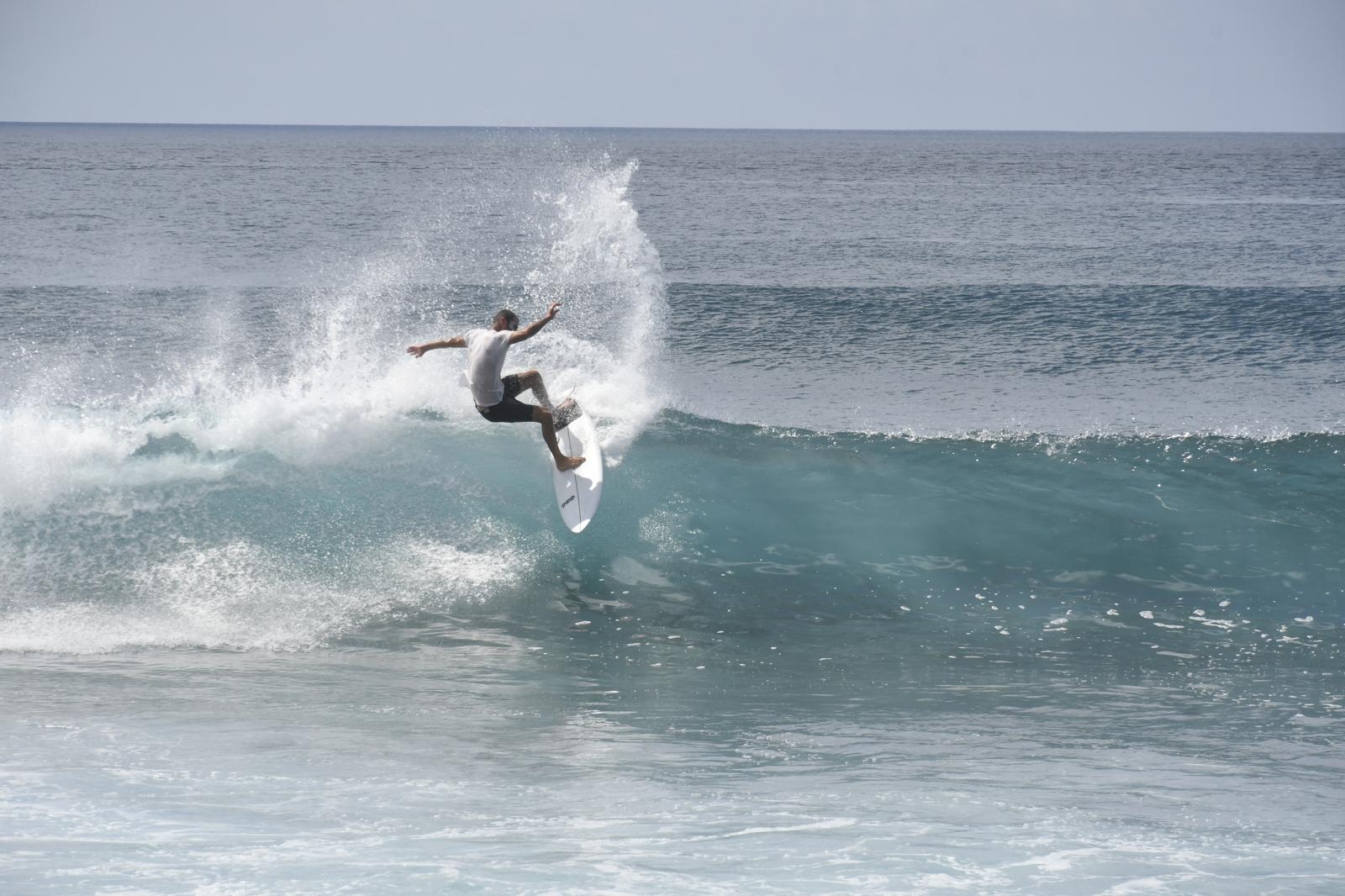
Ricardo Ribeiro, aka Xolim, is one figure in Azorean surfing, having founded projects such as the Azores Surf Center and the Festival Sargo, which takes place annually in March, promoting the fusion of creativity with the celebration and protection of the ocean, and commemorating Ribeira Grande as the “Surfing Capital of the Azores”.
A native of Vila Real de Santo António, in the Algarve, he moved to São Miguel to study Public Relations and never wanted to leave the archipelago again, being surrounded by the sea spoke louder. He was a coach at the Clube Naval de Ponta Delgada surf school, created in 2009, having trained Jácome Correia, one of the best-known Azorean surfers of his generation. A journey intimately linked to the sea, starting in Sagres, where he began surfing, and today in São Miguel, fusing a love for waves with respect for the oceans and their ecosystems.
1. You were born in mainland Portugal, but you ended up building this life project in S. Miguel. Was it an intentional choice?
It was. I came here in 2003 to study Public Relations and Communication. It was always a goal of mine to have an academic background, but obviously, it had to be somewhere with the sea and waves! That was the main priority. I always wanted to live on an island, I had a great friend living here who helped me in that initial phase, and all the factors just came together. When I arrived and started getting to know the island, I just thought: “How is this not world-renowned?”. People talk about Hawaii, the Maldives… and here we have hot springs, waves, nature everywhere, culture, and safety. It’s an authentic paradise. And here I am to this day.
2. What was it like growing up in the Algarve and what is your initial connection to surfing?
I was born in Vila Real de Santo António. The sea and surfing were always the most important things to my group of friends and I. Since our southern coast has few waves, our habit was to go to Sagres. Today there’s the Via do Infante, but 30 years ago we would take the EN125 (an Algarve national road), and it would take us about two hours to get there. We were kids, we had to get a friend’s dad or older brother to take us. It was always a mission and things were very wild, there were very few locals. But it was a very special phase, we were discovering the coast, the waves… If there were no waves, we would go fishing, diving, or canoeing. It was what paved the way to where I am today and what influenced me the most as a person.
3. You are widely associated with various initiatives linked to surfing and the sea. What drives you to create?
I think it was the natural unfolding of opportunities and my passion for surfing. My journey started in 2009, a bit backwards: I started giving competition training at Clube Naval de Ponta Delgada to kids who already knew how to surf very well, like João “Tricky” Alves, Diogo Garoupa, and Jácome Correia. The project was a massive success. We knew we were on the right track when, in the first event of a national circuit, Garoupa made it straight to the final. Jácome Correia himself ended up becoming the under-14 and under-16 national champion.
It was a huge boom for us! As time went by, I felt the need to step away from Clube Naval and create, with my wife, Josie, the Azores Surf Center (focused on those who want to learn to surf or perfect their surfing skills) and the Azores Surf Club (an association to train children, from beginners to competition level). More recently, with my friend and business partner Luís Baldini, we created Sargo. The essence of the festival is to mix surfing and art, which evolved into a festival featuring cinema, artistic interventions in the municipality (like the one we did in this year’s edition in Fenais da Ajuda, which you have to go see), but also a beach market and talks on environmental education and ocean preservation.
4. What do you most enjoy discovering in your work?
I love discovering how to make things happen, not just confined to one place, but spread across the municipality, involving people. In my perspective, the more we add to a project, be it different places, people, or artistic and personal visions, it all shapes something much bigger than originally planned. At Sargo, for example, the idea is to have specific artistic interventions that become special, instead of filling everything with graffiti or excessive urban art. I enjoy that discovery of creating a mold for the festival that is attractive and, at the same time, shares knowledge and entertainment with those who live here.
5. The last person, book, image, object, or song that inspired you?
My inspiration comes from day-to-day life. It’s about being attentive and not letting a banal day slip by. The secret is keeping curiosity alive. Now, with my two kids at home (Koah, who is five, and Maya, two), that spirit of discovery is fostered even more. A simple little thing that holds no importance to us is magic to them. They are newcomers to this world, so everything to them is ”overwhelming”—a tree, the sun, a rainbow. That reminds me of the fascination of living.
6. Tell us something that brings you peace of mind.
Amidst the uncertainties of everyday life, what brings me the deepest peace of mind is the certainty that my family is well. Knowing that the people I love are safe, healthy, and have a roof over their heads and food on the table is my true safe haven. Guaranteeing this well-being and knowing that they lack nothing allows me to take a deep breath.
7. What do you look for when you travel?
Here we have two different phases. Before having kids, surfing was always the motto for me and Josie. We went to the Maldives when Koa was only 6 months old, on an epic surf trip. Nowadays, we try to cater more to their interests, without completely neglecting our own. They love nature, going to see castles. We have been exploring the interior of Portugal, things that I previously had no great interest in visiting, and which are now spectacular to discover with them.
8. What is never missing from your travel bag?
A first-aid kit for them, for sure! The survival instinct and the need to care speak loudest.
9. Have you ever felt insularity from living on an island?
I’ve never felt it, not least because living on an island surrounded by the sea was what I always wanted. But I think the secret to living on an island, or anywhere in the world, is having a drive in life. Something that makes you get out of bed with a purpose. For me, it’s surfing, my work, and my family. Having a passion, doing what you love, and having a group of friends you identify with and can share everything with. With that, you can live well anywhere.
10. Who would you like to be stranded on an island with?
With my wife (Laughs)
11. Best place to go for a swim?
Água d’Alto, without a doubt.
12. A memory, place, or smell from São Miguel?
The road going to Capelas in the summer, when it is completely full of “novelões” (hydrangeas). When I came to live here, I often had to commute to work in São Vicente on a motorcycle. I remember passing through that road and feeling like I was in a dream.
13. What is “The Art of Living” to you?
I’ve been thinking about that quite a bit lately. To me, it’s ensuring that your presence in the world is the least offensive possible to nature and to others. It’s being as non-invasive as you can be. Your passage through this plane has to be something positive, it has to add value and help the place where you live, and not the other way around.